


Note: Here is a podcast/audio version of this interview.
The first time Sharon and I met was in a breakout room on Zoom during Covid.
We were talking about donor networks and organizing. Sharon vented about how important she felt it was for wealthy progressives to go towards the other wealthy people in our lives, rather than distance ourselves or push them away. I sat there pointing, gesturing, trying to show agreement in every non-verbal way I could. I remember shouting “Yes, yes, yes!” after she was done speaking.
Sharon is an important leader in US based efforts to organize the rich towards equity and justice. She is the board chair of Donors of Color Action, board member of Women Donors Network, and emeritus president of the Progress Alliance of Washington [the C4 state donor table for WA]. She is an Asian heritage woman who became wealthy, along with her husband, working for Microsoft in the 90’s and 2000’s.
I interviewed Sharon last Fall and loved our conversation. It was full of laughter, personal stories, thoughtful reflections and a passionate impatience with the current limitations of this work.
If this nascent movement of the rich is to reach its full potential, we need to expand beyond people like me…the brave, guilty, and earnest white inheritor. Sharon Chen can help us learn how.
This interview is from November 2024 and has been edited for content and clarity. The full playlist of video clips can be viewed here.
Mike: I’ve been using this question recently as one way into the conversation: What's your earliest memory of money?
Sharon: It's Fall, Halloween time, in central New Jersey. Metuchen: a small town, two miles in diameter, on the Northeast Corridor line. What flashes in my head is my mom holding my hand while I carry one of those little UNICEF boxes that you take to collect quarters and dimes when you go trick-or-treating. Those boxes were a great excuse for me to learn about the different coin shapes and counting. I loved that.
Mike: Was it your neighborhood or did you drive to a wealthier neighborhood for trick-or-treating?
Sharon: Back then we didn't drive to other neighborhoods. I didn't even know there were wealthy neighborhoods. The UNICEF boxes came from school. We took them home and returned them afterward.
Mike: Wow. I have that memory too. I remember walking around with those UNICEF boxes, and being very excited about it.
Sharon: Who doesn't love knocking on doors and getting something from people? It was more fun than selling Girl Scout cookies. Looking back now, where I lived was a straight-up middle-class neighborhood. I didn't think of it as middle-class then – I had no concept of class.
Mike: Similar question – what's your earliest memory of taking political action?
Sharon: It’s later than you'd think! Probably when I started board service for the Washington Toxics Coalition, now called Toxic Free Future. This was about 20 years ago. At the time, I didn't realize how difficult it was to make change in the public sphere.
Working at the Washington Toxics Coalition on chemical policy reform, I initially believed education was the key – if people just understood the facts, they'd make the right decisions in the legislature. I quickly learned this was wrong. Science rarely determined how people actually voted on bills.
For a while I thought, "Oh, it's just that one bad politician. Once he's gone, things will be okay.” What seemed to me like common-sense decisions about inappropriate use of toxic chemicals would be resolved. But no, you take out one legislator and there is still this never-ending stream of much bigger issues blocking your way.
That was my earliest activist work. I was in my early 30s – coming to these realizations later than I’m proud of.
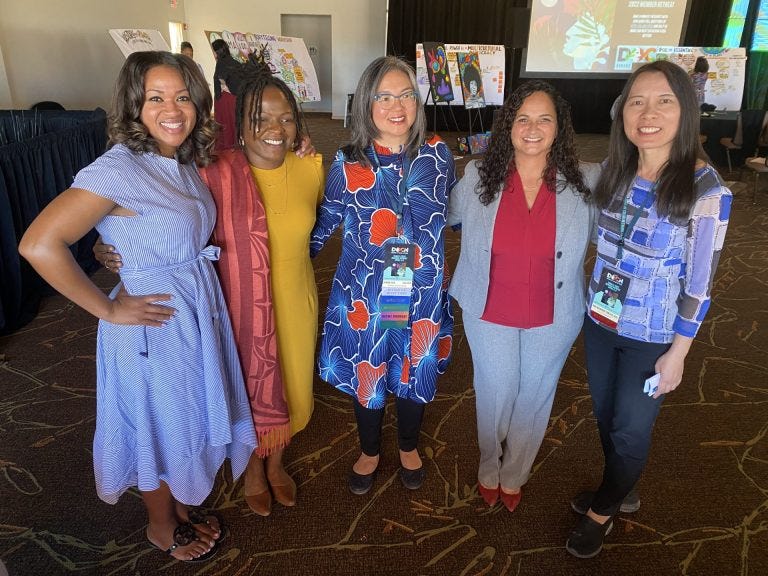
Mike: What's your class and race background, and how did you come to this work of organizing the rich towards justice?
Sharon: I'm the child of immigrants from Taiwan who met in the US in the late ‘60’s. There wasn't substantial wealth in my family growing up, though I consider my upbringing very privileged. I didn't go hungry, didn't worry about housing. I was warm, safe, and dry. My parents made it clear my priority was to do well in school.
I was fortunate to go to school in the ‘90s. I had a knack for math, science, and computers when computers were brand new. It's funny – I started college at Princeton University as an Engineering major and didn't switch to Computer Science right away. It took two years of hemming and hawing about it because computer science was deemed risky – who knew what this flash-in-the-pan computer science might be?!
[laughter]
Engineering was considered reliable. This was in the early ‘90s, and I was one of three women graduating in a class of 25 people in computer science.
Mike: Wow.
Sharon: Now it's a massive department, but back then it was little. I was the only engineer of the three women in our department – the other two got Bachelor’s of Arts degrees. And yes, I was the only woman of color.
Mike: That's a big deal!
Sharon: My degree led to a full-time job at Microsoft. That's basically the story of my good fortune.
I also married another “Microsoftee,” so for a while, we were a ‘double income and stock options’ family. I eventually had three children, but after the second one was born, I semi-retired. It wasn't really retirement – it was more like, "I don't need to work for pay anymore."
I love computer science and the puzzles I got to solve, but working in technology in the 90s as a woman of color… I’ll just say…it wasn't great. I always thought: I need to figure out what to do when I “grow up.”
During that period we moved to Taiwan for two years. Why not? I'd always wanted to live in another country. Growing up as a kid of Taiwanese immigrants, I had some basic Mandarin language skills. I'd always dreamed of living in a Mandarin-speaking place because it would be easier for my kids to pick up the language at that age.
My husband continued working with Microsoft in Taipei. I focused on developing my language skills. The kids went to school – I went to school too.
Mike: This was after your early retirement?
Sharon: Yes, after early retirement.
Mike: So basically you're parenting full-time but also learning Mandarin and living in a new country?
Sharon: Right, because my personality won't let me just do one thing. [laughs]
Mike: Hah, I'm starting to learn that.
Sharon: These were the Obama years, 2008 to 2010. I had a great time [laughs]. But realistically, my language skills were never going to be sufficient to work in Taiwan. Learning Chinese and becoming literate as an adult is a huge investment. So that and other family factors brought us back. We'd considered staying – we loved it there! But Seattle was home, so we returned.
Shortly after, I rejoined the Washington Toxics Coalition board around 2010, getting involved in issues I cared about. I had the financial flexibility to not need another tech job. I could do whatever I wanted. I'm a seeker type of personality – I felt in my gut how I wanted the world to be, while still learning how it actually works. During that period, I kept asking myself: what is my highest, best use?
I am a wealthy person. I live in Capitol Hill in Seattle. When it comes to donor organizing, that's a part of my identity that cannot be denied. There's no hiding that I don't worry about money. When I go to the grocery store, I don't look at prices. When my kids come with me, it's only a matter of "Is it going to be healthy for you?" not "How much does it cost?"
Mike: Oh my God, I know. Sharon, I relate. It's incredible to go to the grocery store and not need to look at the prices. I mean, I sometimes do because it feels like the responsible thing, but not because I have to.
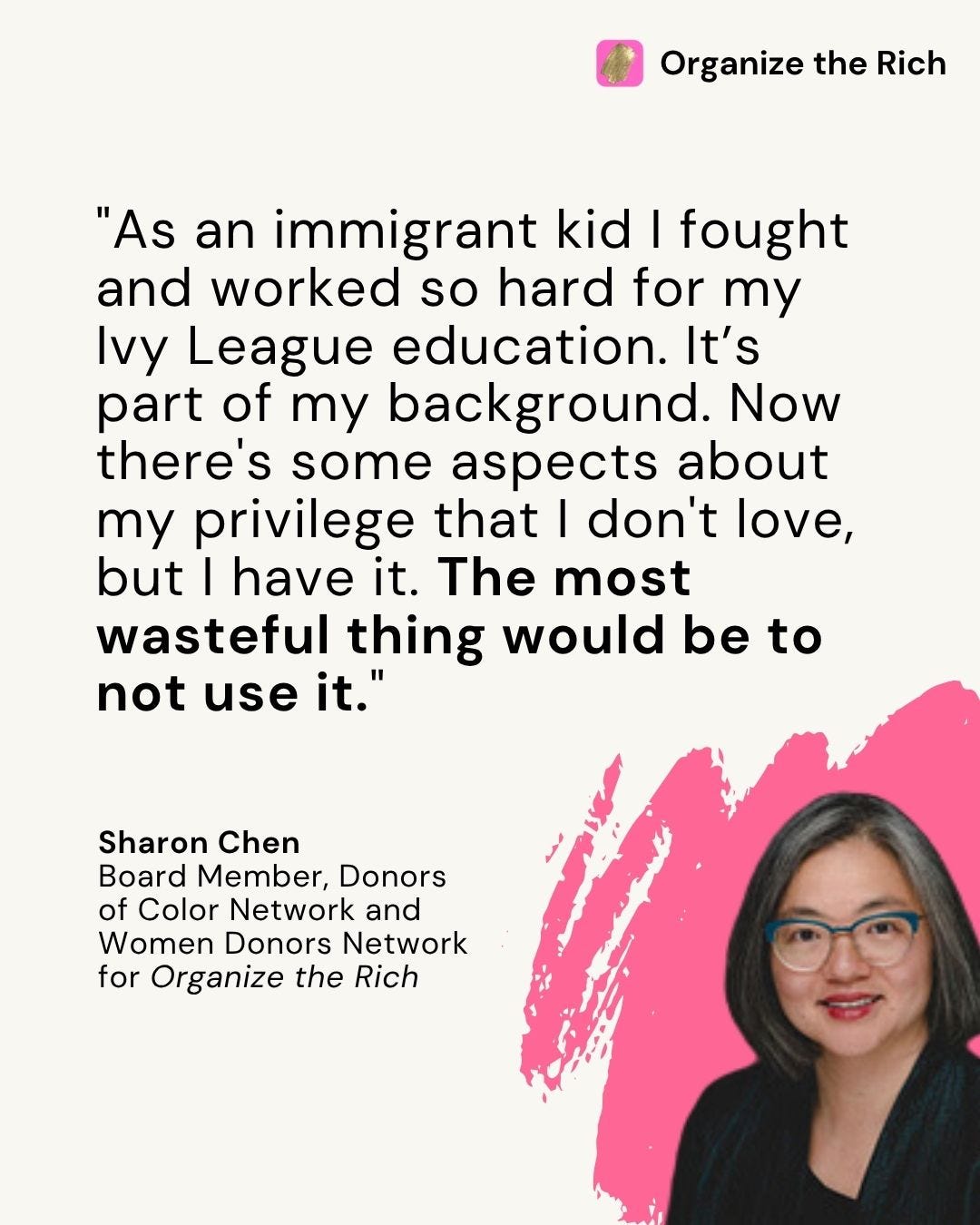
Sharon: Exactly. As an immigrant kid I fought and worked so hard for my Ivy League education. It’s part of my background. Now there's some aspects about my privilege that I don't love, but I have it. The most wasteful thing would be to not use it.
My background and willingness to use it makes me fearless. I'm never going to be in a room and feel a certain type of fear. I'm subject to imposter syndrome like any other woman, particularly as a woman of color. But this idea that I'll talk to somebody and feel like they're somehow above me – it's just not going to happen.
This Ivy League degree gave me that. So many super talented, amazing people I work with don't necessarily have that same confidence. If I can be their tour guide or representative or ambassador into wealthy spaces, then I will do that.
Also, I know what it's like to be a wealthy person thinking about where to place resources. I want to help fundraisers, organizers and other wealthy people by explaining what my barriers were to giving away more money faster and what ultimately helped me escalate my giving.1
Mike: One of the reasons I wanted to talk to you is because I heard you talk about how important it is for the rich to go towards the wealthy people in their lives, rather than away from them. You were talking about this dynamic where wealthy people become politicized around inequality, see how unfair our economic system is, and then turn away from those "bad rich people" in their lives.2 You talked about how that's the opposite move we need to make – we need to go towards our people and organize them. Can you tell me more about that lesson?
Sharon: First, I understand the inclination. Sometimes I may not want to share where my [Ivy League] degree came from depending on the group I'm in.
Mike: You don't wear your Princeton sweatshirt everywhere you go.
Sharon: I don't. [laughs] Although I have one – I have several!
Mike: I love your honesty.
Sharon: As I had my eyes opened to the ways wealthy people can act badly, there was a bit of shame – "Oh gosh, my people did this!"3 It's embarrassment, not wanting to be associated with that group.
But where my mind goes is: if not me, then who? If not me, then who, literally – who's going to reach my people but me?
As someone who came to understand how the world works relatively late in life, I believe in people's redemption. If I believe in my own redemption, then why wouldn't I believe in other people's redemption?

I mean, I got a degree in computer science. If you had told me at 20 years old that I would be interested in politics 20 years later, I would have thought it was a joke. In some sense, back then, I didn't care about people. I didn't care about how big societal decisions were made. I thought, “What a mess! No way I want to get involved in that!” [laughs, raises hands with palms out to signal “stop”]
I was subject to the same cultural messages that many people face: that politics is messy, it's unfeminine. As a woman, you're uglier than you would be otherwise if you think about politics. It's crude and uncouth.
I think those messages are part of patriarchy and there to make sure women don’t get involved.
When I started thinking about politics not as this ugly thing but realized that “politics” just means “how people make decisions”... then why wouldn't I want to have some influence or connection to that?
Mike: Amen. Some people who identify as progressive or left have an allergy to power. They think if you have power, you're bad, and because of that, try to avoid it, even to the point of being anti-leadership and wanting flat structures. The fact is, we need to be able to learn how to build, hold and wield power.
What helped you turn the corner from the techie engineer who didn't really care about people to somebody who did? Were there certain mentors or experiences that politicized you, that got you on this track of seeing the world differently than what you thought it was?
Sharon: There are many things, but what comes to mind is that in 2014, Tamir Rice died.
I just couldn't wrap my head around how a 12-year-old child could be left to bleed out over hours while police officers stood around. He wasn't killed instantly. He was shot and left there. His sister was literally feet away, restrained in the back of a police car and not allowed to comfort him in his last hours. The inhumanity was just so striking in a way that I didn’t understand.
However, it's not like he dies and the next day I awaken knowing how the world works. But that part of me that's a seeker – asking why, why, why – was lit at that moment. I started to read, to listen, to pay more attention to the ways that race informs everything. It put a richness, unfortunately, to understanding our history that I didn't have.
Mike: We don't get that history.
Sharon: It's shameful, actually. I got the best education this country can provide – public school in a relatively rich suburban New Jersey, then an Ivy League university.
But looking back, the holes in my education are profound. I didn't know much about the Black Panthers, but if someone had asked me, I would have said, "Oh, I don't know anything about them, but I think they're like a radical, dangerous group." Which turns out to be exactly what the FBI intended. The reality is they came up with school breakfast and lunches, and community health care.
Mike: Yes!
Sharon: My initial attraction to advocacy and activist spaces was through the environmental route, understanding that the root of climate change isn't merely too much carbon in the atmosphere. You have to ask: Why is there too much carbon? It really comes down to how our culture and how our economy works, based on exploitation and extraction.
I work a lot now in environmental justice spaces, and I'm interested in solutions that address that root cause. There will always be people working on technological solutions, like better batteries. But it's been proven that with more efficient light bulbs, we don't use less energy – we just leave lights on more often.
Technology is not the answer.
Mike: Amen.
I want to switch gears a little bit. You're in the leadership of two different types of donor groups – Women Donors Network and Donors of Color Action. What's the importance of those two spaces for you?
Sharon: I'll start with Women Donors Network (WDN). We talk about the difference in girls' learning in school settings when boys are around. Those gender dynamics play out even in wealthy donor spaces. I'm a relatively new member, just 6 or 7 years, but it's been around for 20 years. What we’ve learned over that time is that without the male gaze, women will be more radical. They won't feel a need to defend their sense of justice.
Looking at the history of decisions at WDN, the willingness to take risks on potential grantees is amazing. One of my favorite stories is about a member who met LaTosha Brown. LaTosha wanted to rent big buses to drive around the South getting people registered and out to vote.
Mike: I’ve heard of her. She co-founded Black Voters Matter.
Sharon: Yes, this was before anyone would give her the time of day – WDN said, “Ok, we'll give you the $70k you asked for your vision of buses.” The payoff was incredible. They started bus tours in 2018. Their 2020 election cycle bus tours went to 15 states and are credited with helping increase Black voter turnout in Georgia elections, including the crucial 2021 Senate runoff election won by Reverend Raphael Warnock.
I'm hopeful there will be a world someday where we don't need women-only spaces like this. But the reality is, having women make decisions without the pressure of the male gaze is important.
Mike: Last time we talked, you mentioned the power of spaces for women to strategize about how to take on sexism and patriarchy in their families and relationships, especially around taking ownership of money. You mentioned some leadership development practices you learned in WDN. Can you talk about that?
Sharon: Women and gender expansive people tend to police ourselves and how we use our power. WDN is a space where we reflect on our tendencies, push ourselves to speak up, to take action, to trust ourselves. We once had a trainer come in to lead us through power poses and vocal exercises. Literally, we practiced taking up space and using our voices.
Those of us who are not men tend to feel like we need more preparation, study and education before taking action. I’m reminded of studies about women applying for jobs – we tend to shy away from job postings that are a stretch; we want to have all the qualifications. That's not as true for men.
Mike: No, us guys will just jump in even if we have no idea what we're doing.
Sharon: The same goes for making donations, what we often call “investments.” To not leave power on the table, we need to shorten the gap between willingness and action. When we understand the psychology of our members, we can address it. We can speak intentionally about it: "Hey, self-doubt is something that's going to hit all of us. If you are planning to invest and suddenly feel a wave of ‘Oh, I don't know enough,’ that may be true, AND ALSO we're going to feel that way because of sexism." These are conversations we can have in a gender caucus that would be tough elsewhere.
Mike: Thank you. That makes sense. Can you talk about Donors of Color Network and what you've found is the importance of that space?
Sharon: There are many analogous situations between the women's space and the donors of color space. At DOCN, we get to see what kinds of decisions a bunch of people of color make without needing to manage the emotions of white people. And we get to practice solidarity across race. These are muscles that need to be exercised.
Just because we’re all targeted by racism doesn’t mean we don’t hold prejudices about each other or understand what each other face. As a person of Asian descent, I've had the opportunity to learn about the Movement for Black Lives. And my Black colleagues at DOCN have learned from me about what it's like to be Asian, and about anti-Asian racism.

Many of us who have become wealthy have experienced separation between us and the poor, working or middle class communities we come from because of our striving. Yet when we talk about many parts of our social justice movements, people of color with wealth can feel a real visceral connection. It feels less like charity. There's many ways we're different from white philanthropists.
Mike: Thanks for explaining those pieces.
I gotta say, you have a unique organizing superpower, which is that you are a former techie in Seattle that speaks that language and knows that world. Your experience and roots in that community give you a real chance to move people and inspire other techies. I’m so glad you’ve gone towards this wealthy community you’ve been a part of, rather than away from it.
Sharon: A lot of the donor organizing I do is code switching between social justice movements and this wealthy donor class. As a child of immigrants, I've been doing that all my life. I code switch between all sorts of communities, and this is just another one.
I also want to say – we’re really good as a progressive left at saying “hey, it’s important that we have cultural competency about this or that community.” As much as we study Asians and civic engagement (or any other community of color) – guess what?! The wealthy donor class is used to being behind the microscope, but it deserves to be and needs to be under the microscope as well.
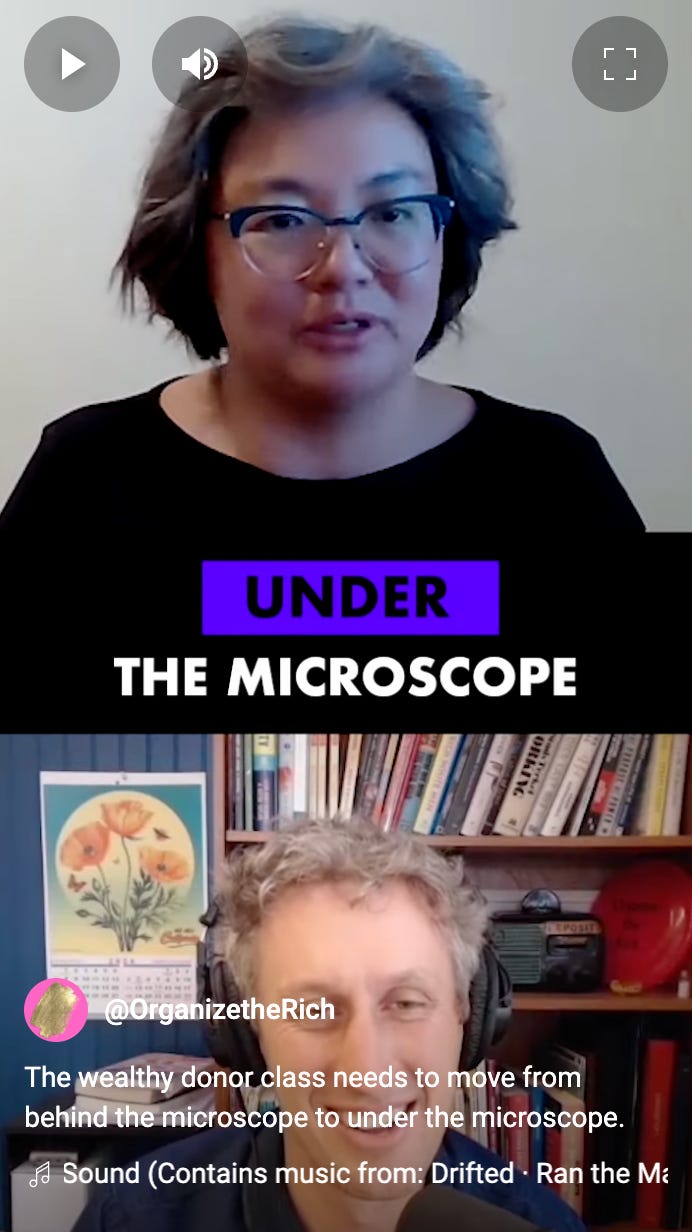
Mike: Ooh. Yes! Please tell us about the research you’d like to be doing on wealthy people.
Sharon: Ok. I need to give context for why I believe research matters.
Washington state is currently 49th in the nation in terms of regressive tax policy, which is terrible and quite surprising for a state perceived to be as blue as it is. We have no income tax. All our taxes are based on sales tax, very regressive things. We've climbed from 50th to 49th because we're starting to make progress with capital gains taxes.
We started making progress after being in the wilderness on this issue for decades. About 17 years ago, the progressive donor community in Washington decided we'd had enough. We knew about the libertarian roots in this region but we didn’t let that stop us. We put money together for sociologists to study people's worldviews about taxes.
From that research, we figured out messages that would break through the knee-jerk "government is bad, taxation is bad" reaction. We started talking about an "upside down tax code" because the word "regressive" wasn't breaking through. We learned to focus on tax revenue as investment – what do you get with your money? People are willing to invest in their communities, but if you're just talking about taxation, you're on the wrong side of the conversation.

Having this experience of being in the wilderness politically for 15+ years and having the discipline to be patient – not trying to win tomorrow's election, but doing the deep cultural understanding and shifting work over the long term – that's what started to break it open for us in Washington state.
Right now we're in a similar situation, needing more wealthy progressives across the country to invest in grassroots electoral organizing. Donor organizers like me have lots of stories…we have been operating on instinct about what feelings are in the way of wealthy people supporting political work. But I'm trying to be open and not presuppose where the problem is. Maybe it’s the fundamental belief in politics being bad, and then other conclusions follow from there.
I’m committed to researching this topic in a similar way to how we researched the issue of taxes in Washington state. We need to look through the microscope to get a clear picture of core attitudes and beliefs, then discern how to help wealthy progressives understand the importance of – and invest in – grassroots movements to win governing power.
Mike: Amen. I can’t wait to see what you find out. Thank you for taking the time to talk with me today. I’ve loved our conversation.
If you liked this post, please share it with others, comment below, click the heart below to boost it in the Substack algorithm, or restack it on Substack Notes.
Reading this now, I want to know what Sharon’s barriers were to giving more and what ultimately helped her escalate her giving! A subject for another conversation.
There are certainly times when it makes sense for wealthy people to distance ourselves or break off relationships with individual wealthy people in our lives because of their negative impact on us. Healthy boundaries are different from this organizing orientation Sharon and I speak to here.
I asked Sharon what she meant by “this.” She wrote, “I’m referring to behaviors that are a result of wealthy people’s economic/social standing that are not helpful to anyone, including ourselves. The biggest one that comes to mind in the context of philanthropy is the notion that we know better than the professionals we are partnering with, such as nonprofit staff or movement leaders. This notion is based on an incorrect assumption that people with money are smarter and that our role as funders is to evaluate the work of organizations we support. Once we've decided WHAT kind of change we want and assessed WHO we want to work with, we need to trust the HOW to make change to someone who has literally developed PROFESSIONAL skill in the area. A little humility and willingness to learn goes a long way. Too often we get in the way of the change we want because we are confused about the role of our money. We approach our philanthropy as some kind of consumer behavior and it holds us back from the positive impact we could achieve with the dollars.”