

I have been intending to finish up this piece and share it here for at least 2 years. I am thankful to have had the time this Summer to push it over the finish line and post it now.
For more on how we organize the rich, please read Transformative Donor Organizing: The Developing Theory and Practice by Isaac Lev Szmonko. This booklet includes important topics I don’t cover below, like what accountability looks like in organizing the rich, while sharing more detail about the theory and practice. If you’re intrigued by what you read here, I highly recommend downloading or buying a copy of Isaac’s book.
“The mission and purpose of organizing is to build power. Without power, we are unable to change conditions in our communities that hurt us. A movement is successful if it transforms the dynamics and relationships of power.”
- Alicia Garza, from her book, The Purpose of Power
The title of this Substack is Organize the Rich. So I thought I’d take a minute to write about what I mean by “organizing.” It’s a term that is thrown around a lot and has different meanings depending on the context. I’ve “organized” playdates for my son, but what I’m talking about is different than that (or is it? hmm).
Background
As a child, on lonely afternoons, I would stare out my bedroom window in my foggy Inner Sunset neighborhood of San Francisco. From my second story perch, I looked out over a patchwork of backyards, fenced in, divided up. I pictured myself going door-to-door, convincing all my neighbors to knock down the fences and make one big mega-yard where I could play with the children I imagined lived in the other houses. I didn’t know it then, but I was dreaming of being an organizer.
When I was 8 years old, I graduated from daydreams to real life action while door knocking for Jesse Jackson’s presidential campaign with my mom. There was nothing glamorous about what I remember from that day. I carried the signs while my mom talked to any adults who answered the door. I was intrigued, curious, and a little bored. It did seem slightly magical that, with these signs and this clipboard, we were transformed into people who could knock on every door in our neighborhood. Is this what it took to make change?
Skip forward many years and I’m at a warehouse in West Oakland. It’s the year 2000; I’m about to be a sophomore in college. I’m shyly standing on the outside of a crowd of youngish people, mostly in their 20s. We’re here to organize to defeat Proposition 21, a California proposition to increase the penalties for crimes committed by young people. A young woman leads us in a chant, then describes the trainings taking place in the rooms of the mostly empty warehouse. There is a door-knocking training, media training, and a space for folks who want to plan marches and direct actions. I hardly understand all the terminology and buzzwords she’s using. It’s a foreign language, but one I badly want to learn.
By the time I found Resource Generation (RG) in 2003, my organizer dreams had blossomed. I had been to anti-globalization protests in DC, attended meetings of the Drop the Rock Campaign against the Rockefeller Drug Laws in NY State, and studied abroad in South Africa, learning about the anti-apartheid movement there. I understood just enough about organizing to pretend like I knew what I was talking about (a speciality of wealthy people and men).
In the following years, I learned more about the art and practice of organizing, both from workshops I participated in as a part of RG, and through my involvement with a handful of training programs and activist projects.1
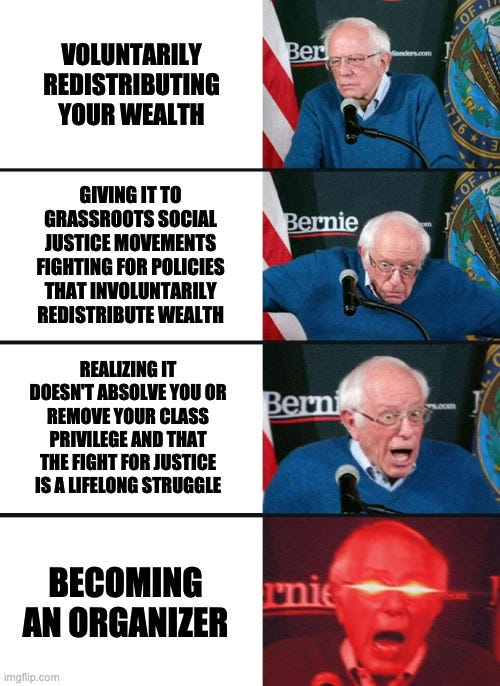
So much of the community organizing I was inspired by was rooted in efforts to move wealth and power away from the rich and back towards poor and working-class people.2 Given that reality, I was always curious, what the heck did it mean to organize the rich?!
To my relief, many of the concepts developed organizing the working-class majority were adaptable to organizing the wealthy.
What do I mean by organizing?
I understand community organizing as bringing people together to build power and take collective action towards a common goal.
Organizing is a practice engaged in by people from across the political spectrum. It is not owned by the left or progressive movements. People I disagree with whole heartedly are often incredibly effective organizers.
Key elements of organizing that I’ve been taught and found useful when organizing the rich are:
A shared analysis and set of beliefs of how the world works (ideology is the fancy term).
Example from organizing the rich: The true self-interest of all people, including the wealthy, lies in a healthy, equitable and just society, an end to classism, and shared prosperity. Redistributive policies and practices are good for the rich and good for everyone else. The current economic and class system hurts us all – in very different ways.
Base Building: Growing the number of people a group is connected to, from the constituency they are organizing, who are willing to take collective action towards a shared goal. Increasing the commitment and skills of those people in the process.
Example from organizing the rich: Training wealthy people to become peer organizers, who can warmly and confidently invite in other wealthy people to the political homes they have joined. This type of peer-to-peer base building is crucial to growth and not something people know how to do without practice and support.
Organization and Organizational Development: To win durable, long-term power, it’s necessary to build organizations that can hold the process of growing a base, developing leaders, and running campaigns. We need organizations to be containers for resources, relationships, wisdom, etc. so that power can be built over time, campaign by campaign, leader by leader, door to door. Then, when we win, victories can be enforced and stick, and reformist campaigns can turn into long-term revolutionary change.3
Example: An individual rich person, like Julius Rosenwald, shifting wealth and power towards poor and working-class liberation movements? Awesome. A whole organization of rich people – like Resource Generation, Women Donors Network, or Solidaire – shifting wealth and power to poor and working-class liberation movements over the course of decades, with formal processes for passing along knowledge, a growing community of members and supporters, coalescing lessons, and building off what’s come before? Priceless.
Leadership Development and Political Education: Leadership development increases an individual or group’s skills to use their unique abilities towards a shared goal. Political education is the collective process of study, research, and learning to understand our current conditions and how to effectively change them.
Leadership Development Example: After attending my first Resource Generation Donor Organizing Institute, I was invited back the next year as a trainer-in-training, moving me from a participant to a member of the facilitation team. Eventually, I was leading workshops for RG.
Political Education Example: At my first conference for young wealthy people, I was asked to fill out an anonymous money survey, sharing the details about how much money my family and I had, where it was invested, how much we paid in taxes, and how much and where we gave. Through the money survey, for the first time, I fully faced the reality of my financial situation. By hearing the results of the survey overall, I learned about wealth inequality in our country and the small % of money given away by the rich. I was lit up by the thought of what would happen if we were to organize ourselves and move the money in our control.
Campaigns: Fights for power today that are training grounds for the victories we need tomorrow. Time-bound efforts to win reforms that shift power. There are many types of campaigns including fundraising, policy, and electoral.
Examples of progressive campaigns that involve the rich as more than just donors to an individual organization:
The FreeYourDAF campaign to stop corporate donor-advised fund providers from collaborating with authoritarian tactics being used against civil society groups.
Washington State’s Millionaires Tax that recently passed in the state legislature.
Resource Generation’s Redistribution Pledge, with the goal of moving $100 million to justice movements every year.
Funded, at least in part, by its membership: Organizing takes money. To pay for the food, buses, flyers, meeting space and more. In general, liberation movements, such as the women’s movement or the farm workers movement, relied on funding from their base. The labor movement has always been powerful in part because it’s funded by the dues of workers, enabling political independence from wealthy individuals and big philanthropy.
What does this mean in the context of organizing the rich?! Membership dues from wealthy members and foundations pay the vast majority of the operating costs of organizations like RG and Solidaire. Asking the wealthy to pay dues and make multi-year commitments to the groups that are organizing us is an investment in ourselves. It challenges the charade that our best (and only) contribution is to fund the liberation of others.
Culture/Joy/Spirit/Faith: This is such a fundamental part of successful organizing and a challenge for me to describe well. It is best articulated in the writings of strategists and writers such as Grace Lee Boggs and bell hooks as well as current-day leaders like Rajasvini Bhansali and Akaya Winwood in their book Leading with Joy or Maurice Mitchell in his article Building Resilient Organizations. We need movements and organizations that know the difference between care and caretaking, can work through big feelings and conflict, engage with our spiritual and religious traditions, and model a powerful, transformative practice of revolutionary love.
Examples from organizing the rich include:
Showing care towards wealthy people outside of their actions as a donor or formal role in an organization. Ie checking in on members when there is a natural disaster in their area, or when there is a significant event in their lives.
Have the ability to say “no” and hold clear and (ideally) kind boundaries with wealthy people, whether they are a major donor or not.
Celebrate victories and prepare everyone that mistakes are not a sign of failure but a to-be-expected outcome of any real effort towards social change.
How is organizing to achieve a goal different from simply purchasing it?
Everyone in our society is encouraged to use money to solve any problem we face, even more so if you’re rich.
Feel sad or scared? Pay a therapist. Need childcare? Hire a nanny. Burnt out? Go on vacation.
This translates over to our orientation to social change as well. Want clean air? Buy an air purifier. Worried about crime? Move to a gated community. Want a well-functioning democracy? Donate to an organization that will make it happen in the way you want.
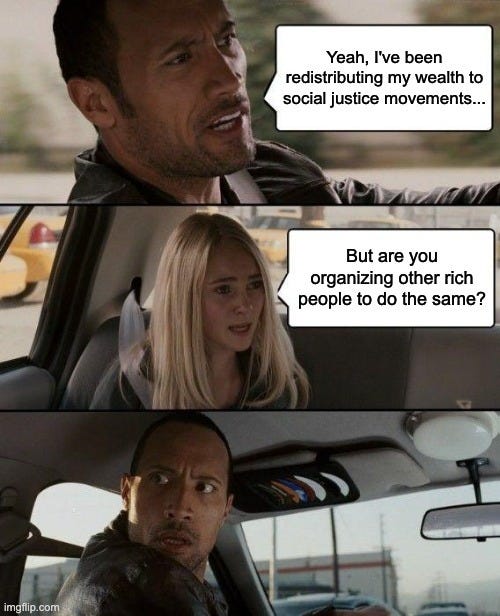
An organizing approach asks more from wealthy people than being a committed-but-distant donor. It shifts the question from “How can I pay others to enact the change I want to see in the world?” to “How can I join with others to make our shared goals possible?” Making a donation is a fine start, but just one of many possible contributions.
Organizing is not a quick-fix and almost never leads to immediate gratification. It takes time and patience. It is not about doing for people, it is about supporting each of us to be powerful advocates in our own right. Because of this, it’s vital to have volunteer leadership contributing throughout the organization. Paid staff are often crucial to sustaining an organization, but without volunteer leadership there is no collective power.
So how can we organize the rich?
My current answer…build a base within the owning class, develop their leadership, cultivate their understanding of the world through political education and collective action, while rooting them in multi-racial working class-led movements. Activate them through campaigns and the engagement of their deep-seated self-interest in a more healthy, just and equitable world.
Easier said than done.
What do you think?
How can community organizing concepts be applied to our work to organize the rich today?
If you like this post and want to support Organize the Rich, please click the heart below, comment, share it with others, or restack it on Substack Notes.
FURTHER READING: Resources about Organizing
Transformative Donor Organizing: The Developing Theory and Practice by Isaac Lev Szmonko
Organization Means Commitment by Grace Lee Boggs. PDF and hard copy.
The Purpose of Power by Alicia Garza
Transformative Organizing by Eric Mann
Stir It Up: Lessons in Community Organizing and Advocacy by Rinku Sen
Fundamentals of Community Organizing by George Goehl
Racial Equity Tools, Community Organizing list of case studies and resources
Community Organizing: People Power from the Grassroots. By Dave Beckwith, with Cristina Lopez. Center for Community Change
Midwest Academy: 50 year old training center for progressive organizers.
Organizing: People, Power, Change by Leading Change Network, Marshall Ganz, New Organizing Institute, Peter Gibbs, Shea Sinnott
This is An Uprising by Mark and Paul Engler.
Organizations I was trained by included the Challenging White Supremacy Workshop and School of Unity and Liberation (SOUL).
There is much more to say about different types of organizing styles and lineages. I only broadly understand the difference between Alinsky style organizing v. transformative organizing v. a more distributed approach. There are many organizing models to draw from. I hope this project and piece inspire new experiments in organizing the rich that integrate lessons from other organizing traditions and build off what’s been attempted so far.
Read more in Organization Means Commitment by Grace Lee Boggs.
Really useful post--and reading list, thank you. I am new to this space, but your core philosophy and approach ring true to me in a deep way, like something so sensical that it seems it should be obvious to everyone, but somehow very much isn't. Really excited to be here and learn and figure out where I can contribute best in the re-education and redistribution landscape.
Great post--informative AND funny!