
Transformative Donor Organizing
An introduction to Solidaire’s little maroon book

As far as I’ve found, the term “donor organizing” was coined in the 1980’s by Christopher and Anne Ellinger, two young people in their twenties who were early leaders in the work of organizing wealth holders toward more bold and generous giving.
The term was an intervention, a push to make fundraising more relational, to see wealth holders as whole people with more to offer than their dollars, and with their own stake in acting on their “love of the world.”
In the 40 or so years since, “donor organizing” has become quite a popular buzzword in the progressive world.1
And yet.
And yet, I’ve never read a detailed explanation of this popular buzzword, and its theory and practice…until now!
So without further ado. Drumroll please.
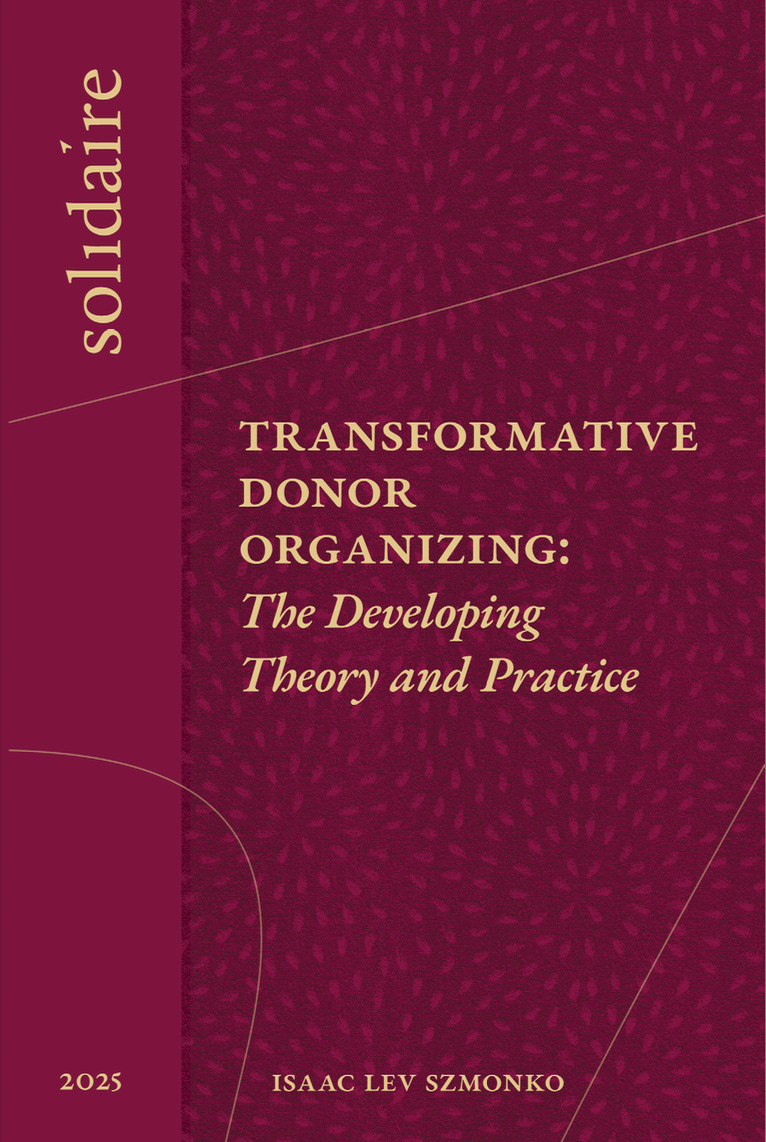
I am proud to announce the public release of Transformative Donor Organizing: The Developing Theory and Practice by Isaac Lev Szmonko, published by Solidaire Network and Organize the Rich.
Based on many decades of work, as well as several years of writing, this little maroon book is the first articulation of the why and the how of donor organizing.
It discusses important questions such as…
What the f do we mean by donor organizing?
Is it just “relational fundraising” dressed up for a night out on the town?
How can donor organizing be a relevant practice in these times of rising inequality and authoritarianism?
And if we call ourselves “transformative organizers,” what the heck is supposed to be transformed?
I am so proud of Isaac Lev and the publication of this book. It is historic and unprecedented. It shares lessons from what we’ve figured out so far as well as an aspirational vision of where we want to go.
My hope is that it changes the game – that for anyone serious about doing this work, it raises the bar and throws down the gauntlet saying, “Want to be a donor organizer?! You can bring this level of rigor, care and strategic thinking.”
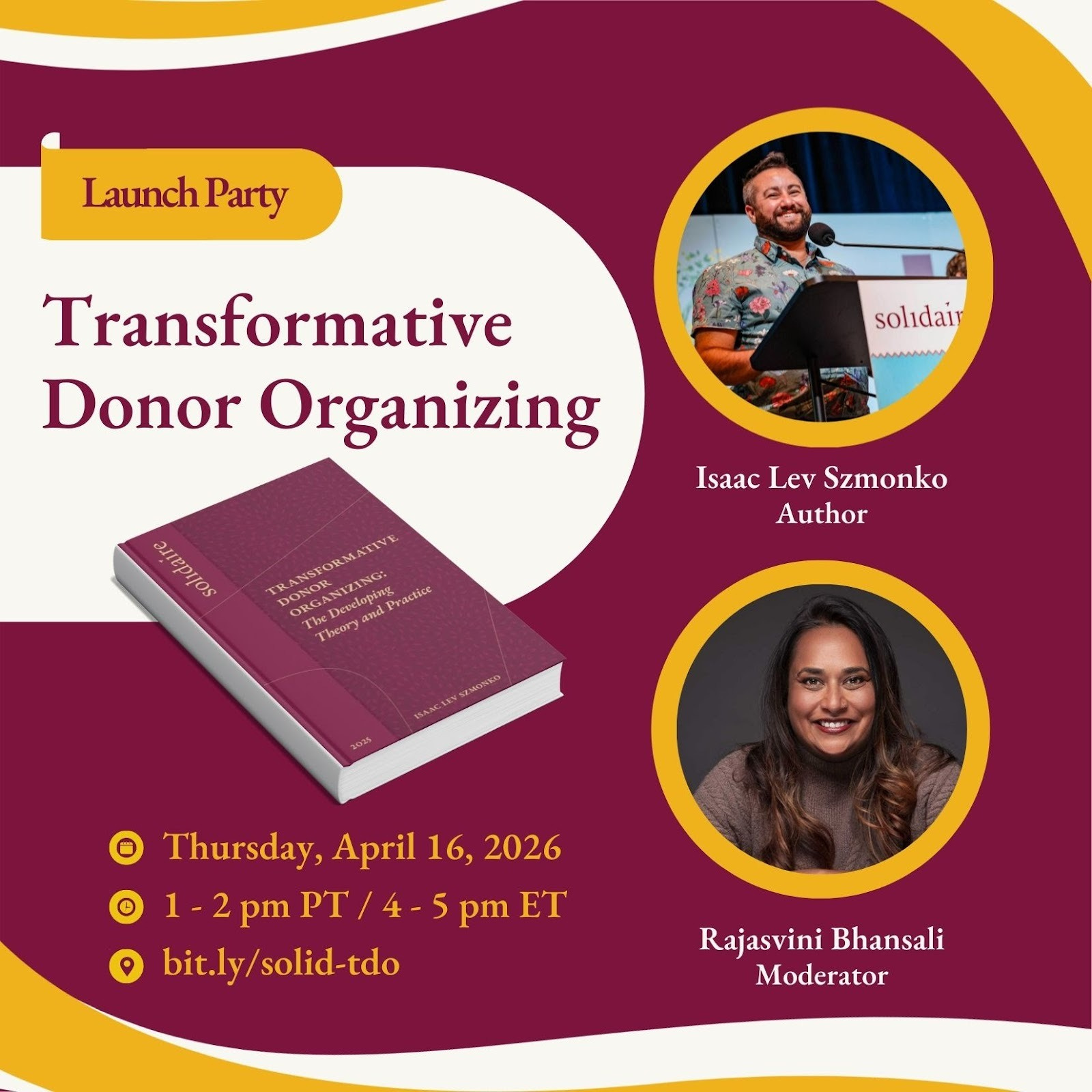
Buy a copy or request a free pdf. If you want to learn more, RSVP for the online launch party on Thursday April 16th, 1-2pm PT/ 4-5 ET. Feel free to invite others.
Isaac Lev will be in conversation with Solidaire Executive Director, Rajasvini Bhansali reflecting on the political moment, what they’ve built together at Solidaire and what it means to organize donors and funders with rigor and care.
If you would like Isaac Lev or someone from the Solidaire donor organizing team to speak with your organization about the Transformative Donor Organizing Model, please contact Amie at amie@SolidaireNetwork.org.
And to pique your interest, I leave you with an excerpt from the executive summary:
We live during a time of rising authoritarianism, climate crises, extreme wealth inequality and militarism. While billions flow into right-wing organizing every year, progressive movements rooted in working-class communities and communities of color remain chronically under-resourced.
Traditional models of working with wealthy progressive people — centered on fundraising and light political education — are simply insufficient to meet the moment. We need to organize as many wealthy people as possible to give the majority of their wealth to grassroots power-building, to leverage their political and social capital in service of Left strategy and to organize other wealthy people to do the same.
This isn’t just about stopping authoritarianism. It’s about making sure that when we win, what stands in its place is not the status quo of racism, wealth inequality, sexism and transphobia, but a real chance for a future in which every human being lives with dignity, love and power.
We need to deploy tens of billions of dollars over the next decade behind strategies that build power in working-class communities and communities of color, and build governing power for the Left. To do this, we need Transformative Donor Organizing.
A Transformative Donor Organizing approach creates rigorous and loving political homes where wealthy people can undergo deep personal and political transformation. It supports them to move from being passive allies to becoming lifelong revolutionary actors who see their own interests tied to the liberation of all people and commit their full resources, relationships and power to building a feminist, socialist, regenerative economy.
The methodology includes the following:
Long-term political homes that nurture belonging, loving community, dignity and accountable relationships to grassroots movements.
Transformative political education that uses storytelling, open-ended inquiry, embodiment, care and radical honesty to change people and not just ideas. This education connects wealth accumulation to systemic violence, helps transform harmful socialization beliefs and patterns, creates a sense of having a stake in collective liberation and builds an understanding of movement visions and strategies.
Leadership development that supports people to become strong organizers for wealth redistribution
Collective action, including pooled or aligned giving, political advocacy and divestment campaigns
Spiritual and emotional work that includes healing, personal and community transformation and the cultivation of a sense of deep purpose and commitment
Practical support to create strategic multi-year giving plans, give in ways that help movements thrive, divest from the stock market and organize their families and wealth managers.
Transformative Donor Organizing is not about perfecting donor behavior; it’s about building the organizing infrastructure to unlock wealth and power for liberation movements, so we can create a different world. The question isn’t if wealthy people can be powerful agents for liberatory change — it’s about whether we’ll build the organizations powerful enough to make that transformation inevitable.
We can transform segments of the owning class into powerful comrades — not just for their money, but for their relationships, skills and lifelong commitment to liberation. We hope this essay is a contribution toward just that.
If you like this post and want to support Organize the Rich, please click the heart below, comment, share it with others, or restack it on Substack Notes.
Yes, dear reader, I continue to be unable to write about “donor organizing” without adding at least a footnote about how I don’t like the way so many use this term as short-hand for “organizing the rich.” Using “donor” to refer to rich people hides the fact that the vast majority of donors are not wealthy, and narrows our vision of organizing the rich to the more limited goal of creating good donors. For these reasons, and more, as articulated by Iimay Ho in this essay “Donors”: If you mean rich people just say so, I generally avoid the term. And yet, it is a term that is easy to say, doesn’t scare away rich people we’re trying to engage, and–for some–actually does encompass a practice of organizing donors across class. It remains the most common way to talk about organizing the rich in progressive spaces, and, without a compelling alternative, is the term used in this book.
Registered ✅
Registered. I've been mulling this over and I feel deeply relieved to see this line of thinking and community support!