
The Alternative Fund Movement
Excerpt from Charity Begins at Home by Teresa (Terry) Odendahl

In the coming month, I’m going to share a couple of posts focusing on the era from the 1970s to the 1990s, when many of the social justice public foundations and early progressive donor networks were founded. Today, I’m starting with an excerpt from Terry Odendahl’s seminal book, published in 1990, Charity Begins at Home.
In other news, Marian Moore, Alex Tom and I are coming to NYC and Philly on June 24th and 26th for book talks, to celebrate the publication of Free the People to Free the Money to Free the People. We’ve sold out every book event we’ve held, so reserve your ticket today! Get your tickets for NYC here and Philly here.
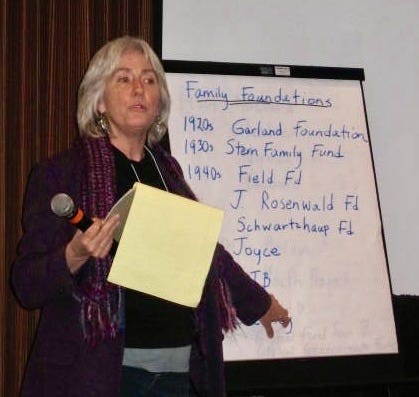
It was 2009, at a Council on Foundations Conference, when I first heard Terry Odendahl share a brief history of social justice philanthropy. She stood in front of a flip-chart stand, scribbling names and dates, painting an incredibly wide-ranging picture of this movement in formation. I was wowed. I was a newbie at the time, just getting my feet wet in the world of institutional philanthropy. Terry was already a veteran leader, accomplished writer and scholar.
Despite this early introduction to Terry’s leadership, it was only a few years ago that I picked up a copy of her book Charity Begins at Home: Generosity and Self-Interest Among the Philanthropic Elite (1990). Given the ambiguous title, I was amazed by what I found when I opened it up. It’s part scathing critique at the self-serving nature of elite philanthropy (think Winner Takes All, but written almost thirty years earlier), part ethnography of the culture of wealthy philanthropists, with a history of social justice philanthropy embedded throughout.1
The excerpts below are from Chapter 8, “The Alternative Fund Movement” (pages 163-186). They focus on the period when many of the first institutional homes for organizing the rich in the U.S. were founded.
Teresa “Terry” Odendahl is a longtime leader, writer and teacher in the world of social justice and environmental philanthropy. Terry was the executive director of National Network of Grantmakers (NNG) for almost a decade, from 1992-2001. In that time, NNG was where progressive philanthropy came together across class, race, gender and role. Terry was the executive director and CEO of international environmental grantmaker Global Greengrants from 2009-2019.
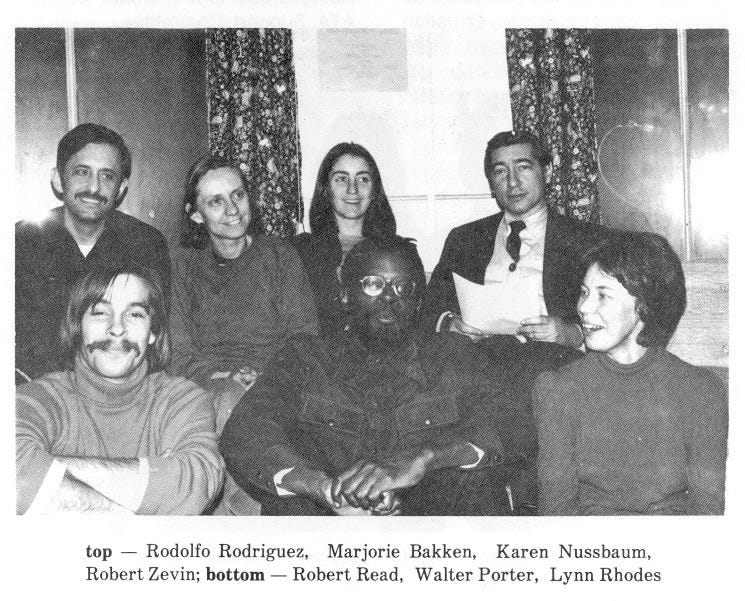
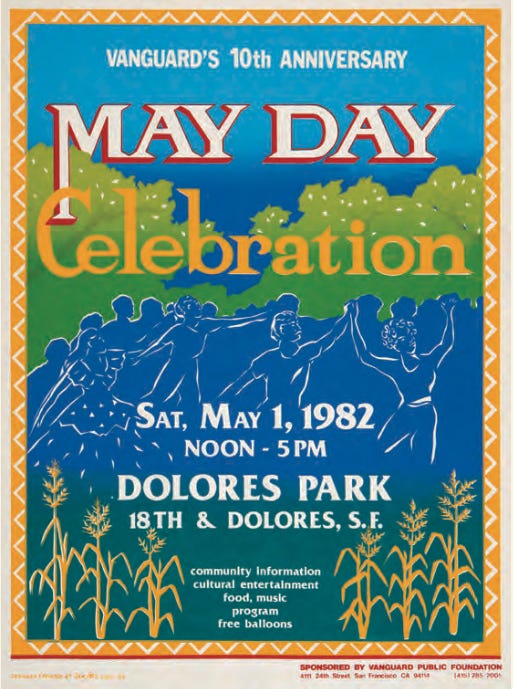
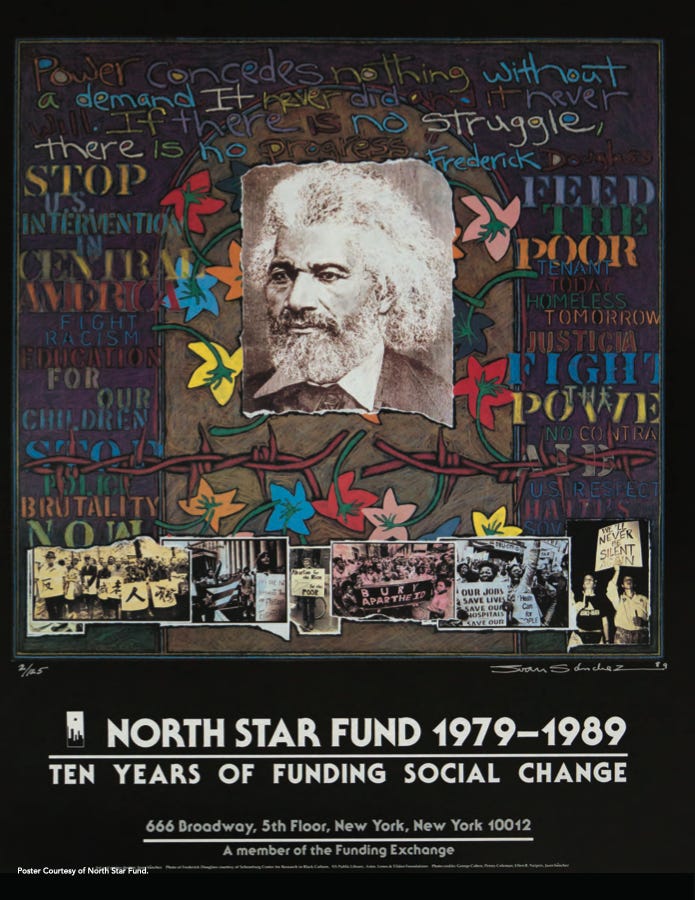
Note: The photos and art below are not from Charity Begins at Home. They are largely from this report on the history of the Funding Exchange, the website of George Pillsbury as well as from these Vanguard Public Foundation annual reports, shared with me by Vanguard co-founder Obie Benz.
We’re people who aren’t satisfied to wait for our wills, just contribute to our alma maters, or give in order to get on local cultural boards. Our motto is change, not charity.
— George Pillsbury, quoted in Michele Willens’ "‘Rich Kids Have a New Way to Give," USA Today, 21 September 1984
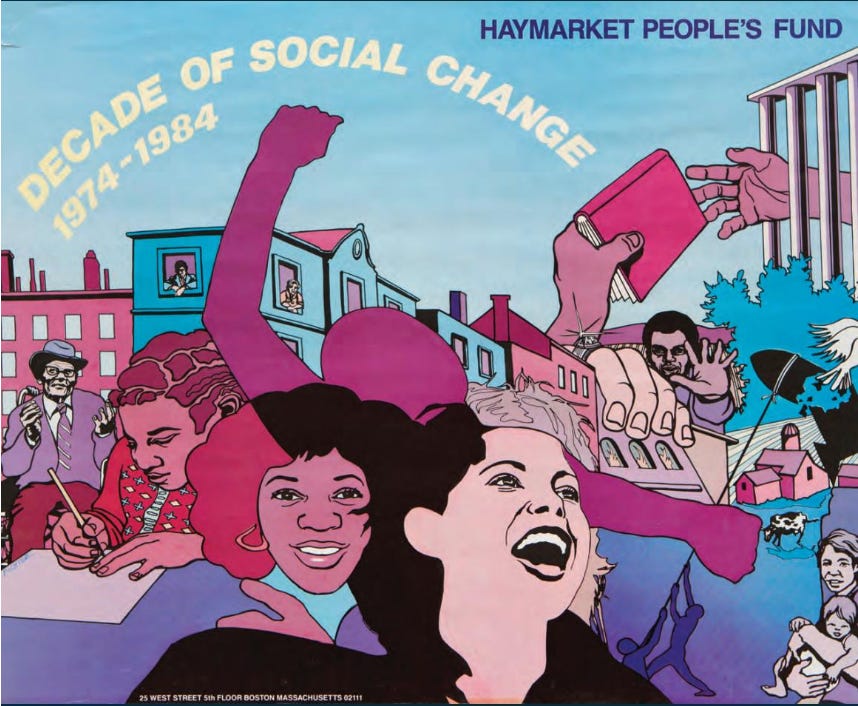
The Haymarket People’s Fund, created in Boston in 1974 to finance activist and grassroots causes in the New England area, is part of a growing philanthropic movement among young people with inherited wealth. Haymarket is different from its fellow alternative foundations, because although they all award grants to a range of politically left or “progressive” organizations, “Haymarket’s funding decisions have been made by a board of community activists, not by the rich people who donate the money.” Haymarket was not the first alternative public foundation in the country, but early on its founders pioneered a grant-making process representative of the communities that were targeted for its funds.
There are now [in 1990] around twenty alternative funds or giving programs in the United States. To varying degrees, the wealthy young people who have formed this counter philanthropy movement have struggled to determine the extent of influence and control they should have in the foundations they finance and, by extension, over the groups that receive the money. Unlike the Haymarket People’s Fund, most alternative foundations have developed a mix of some form of representative community participation as well as donor involvement in grant-making and policy matters. There has been no single organizational model or allocation practice. Several models have been tried in each of the alternative foundations. Each fund has evolved over time, depending on the perspectives of the founders, joiners, and recipients as well as the charitable or political climate of the area where it is located. A majority of these institutions, however, have moved in the direction of an increasingly representative governance and grant-making structure. Though there were contrast and contradiction among the original alternative fund models, over time they have tended to become similar to one another.
…
George Pillsbury, a founder of the Haymarket People’s Fund and heir to the baking goods and food company fortune, is a leading proponent of community, rather than donor, representation on the funding committees of alternative foundations. He was in his mid-twenties when his mother, Sally Pillsbury, told him about the Vanguard Public Foundation in San Francisco.
The Vanguard Foundation had been established in the early 1970s “as a cooperative venture by several young wealthy people to support social change projects too controversial or too risky to find money at more conventional foundations.” After reading Vanguard’s first annual report, George Pillsbury began fundraising and organizing the Haymarket People’s Fund. He worked at this endeavor full time until 1977, and continues actively to support both Haymarket and the alternative foundation concept.
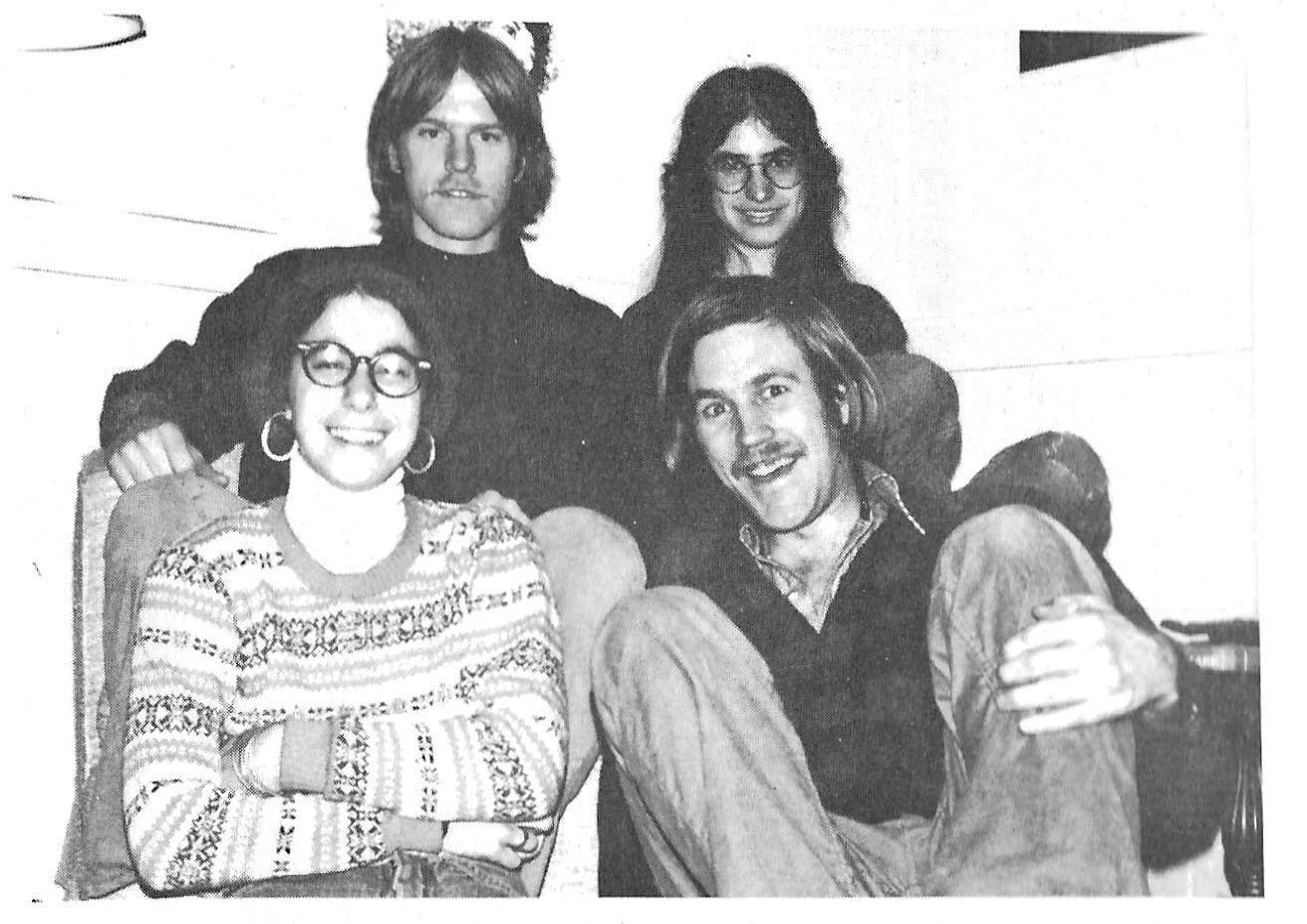
Pillsbury personally recruited many others — including relatives — to the cause. He has claimed that “the movement started at Philadelphia in 1971 with the Bread and Roses Community Fund. The organizing grew directly out of opposition to the Vietnam War and concern about civil rights. There was a wish to fund social activism.” Within five years, Bread and Roses and the Vanguard Foundation, having formed independently, had been joined by Haymarket and then by the Los Angeles–based Liberty Hill Foundation. Liberty Hill was initiated by Sarah Pillsbury, George Pillsbury’s sister, and other co-founders. One of the early donors to Vanguard was Tracy DuVivier Gary, who had been urged by her cousin George to make contact with the fund. After several years’ [sic] working with Vanguard, she helped to form the Women’s Foundation in San Francisco, the first locally based fund that concentrated solely on women’s issues and needs.2
…
The leaders of the alternative funds started by contacting college and prep school acquaintances, friends, relatives, friends of friends, and friends of relatives with wealth. They organized within their own class, in the regions where they lived, moved, or traveled. As a consequence of the efforts and tactics of all these organizers with inherited wealth, most are now known to each other and have multiple interrelationships. Several give to more than one alternative foundation, although they usually focus on their local institution.
Many wealthy young people in the alternative foundation movement have met, dated, and formed businesses or nonprofit enterprises, as well as joined potluck and support groups. Some have even married while setting up and working in social-change funds. Other young donors have sought out emotional and personal support from the elite network members, but self-consciously attempt to modify class boundaries by having friends, lovers, and spouses outside their class of birth.
…
The unique aspect of the Haymarket approach is that its contributors, whatever their economic status, give up control of the money they put into the organization. Staff member Sutphen provided a blunt rationale for excluding major donors from decision making. “It’s hard for ruling-class, white, rich, usually male people to judge what makes sense to fund in the left. It takes time to get inside it, and very few rich people have or take that option. It takes time to develop expertise.” However, the approach of strictly limiting donor involvement has not proven likely to attract many wealthy contributors unless they are provided with added incentives.
The Haymarket People’s Fund and many of the other alternative foundations have multiple purposes. They raise money from the privileged that will be distributed by activists to what they consider needy and worthy causes; provide a support structure for socially conscious people with wealth; and encourage and educate funders about progressive giving. Most of the alternative funds teach untraditional philanthropy and provide a meeting place and supportive environment to young people of means.
…
The San Francisco Vanguard Foundation
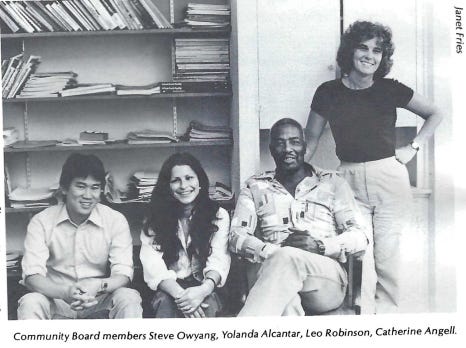
The six original donors to the Vanguard Public Foundation were all women and men of means between the ages of twenty-two and twenty-six. Their number soon grew to a dozen, largely through the dedication and persuasive efforts of one of the organizers as well as referrals from “more established foundations.” Altogether, these twelve individuals constituted the foundation’s first official board of directors. This initial group of contributors is described as having “a variety of political perspectives, ranging from McGovern-type left to completely apolitical.”
…
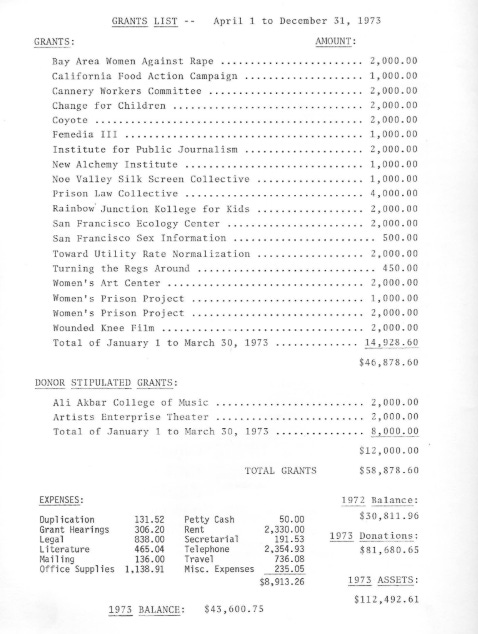
The allocation process at Vanguard was initially performed only by wealthy donors. Then they created a separate board of community activists who also distributed funds. Now the donor and community boards have been merged. Unless someone is a community representative, the minimum donation required to participate on the board of directors or allocations committee is $2,500.
…
More women than men have given to Vanguard. With some notable exceptions, these women donors have tended to be less public or visible than the men. Many wealthy women heirs have had to overcome a socialization that demanded their assumption of the role of a “lady bountiful.”3
…
Several individuals created private foundations after their experience with Vanguard; some participants have helped establish new alternative groups in other areas of the country. At the national level these efforts have led to the Funding Exchange, a network of alternative foundations. At the local level, the Women’s Foundation in San Francisco was partially inspired by Vanguard, and became a model for women’s funds around the country.
A longtime donor
One of the early and ongoing donors to Vanguard is a soft-spoken man who is now in his late thirties. I interviewed him in the sun-filled bedroom of his Victorian flat in San Francisco. We were meeting there out of consideration for the rest of his family, whom we occasionally heard through the door. He sat in a bay window seat overlooking the street and gave affectionate pats to two dogs as he remembered, “It seems incredible to look back on, now that we have quarterly meetings, but at first we actually met every two weeks to make granting decisions. And we would meet in between times every other week for just socializing.”
He indicated that friendships and personal conversations were essential. “I think [they are] an important part of any political organization or effort. It is not always recognized as such, or given much credit. [But] that’s a motivation for people to join. It was certainly true with us.” There was a kind of safety, a feeling that they could discuss a host of personal and political issues with others in the same situation.
Although his own parents were liberal funders, this donor continued:
A lot of us were trying to grapple with some of the contradictions of having progressive political outlooks and having money, fairly opposing sorts of notions that were really felt as contradictions and conflicts. . . . Being able to talk about those kinds of issues with each other . . . helped us to grapple with them a little more concretely.
We have dealt with some people who have been very private and anonymous about it [giving to Vanguard]. I have always been pretty out front about what my position was, my class background and having money. To me, that’s a good course. People can accept that. I have not found it to be a problem. . . . People who are not of the same economic status can accept and I hope even respect my choices.
…
The Amalgamated Rich Folks and a new woman donor
At that point [1974] they were forming something that was called ARF, which stood for Amalgamated Rich Folks. It was a national organization of people who had come from wealthy families that would meet once a year. These came to be the donors and supporters of the Funding Exchange [a national umbrella group of the alternative funds). ARF has since changed its name. It is called the CNP, which stands for the Council on National Priorities.4
“It was a chance for us to exchange [information], and look at political candidates, and talk about the labor movement, and other kinds of issues that we might not be hearing about in our own local communities. Then there were 30 of us; now there are well over one hundred.”5
A new donor to Vanguard, Tracy Gary recounted her history with the organization. “I first went to the ARF Conference, and from that met a bunch of Vanguard and other people. . . . I was very excited . . . I thought, ‘This is a community of people who really care about change.’ I was very moved by it, and wanted immediately to get involved with Vanguard.” Like her peers, Tracy Gary was looking for her place in the world, an identity, some meaning in her life. She did not really know anyone in San Francisco, but was socially well-connected in the East.
My cousin George Pillsbury had come out to visit [the people] who had just started Vanguard. He said, “You should get involved.” And very soon after, I did.
I moved out here in seventy-three. . . . I had “come out” in 1969 as a debutante. . . . This was not for me. I loved the parties, but I thought, “This is a ridiculous amount of money . . .”
When I came out here it was really in reaction to not wanting to do the New York lifestyle. . . . I first went to a meeting in 1974. It did not seem like an East Coast group of people. . . . It was really clear that they had some of the values I did — from the sixties.
…
I worked from five to ten hours a week with Vanguard between 1975 and 1978. . . . I learned a great deal about going out on interviews [with potential grantees], but also got very impatient with what I saw to be a lack of sufficient organizational structure and planning.
I was volunteering in other community groups during that time. Vanguard would be giving them two thousand dollars or something, but the technical assistance needs were so great. Oftentimes what would happen is I would stay and work with them on the organizational things. I would try to help them get other money, or think about a fundraising strategy.
At about the same time I got involved with the first battered women’s shelter here [Vanguard was the first organizational funder] — and was picked up quickly by the [women’s] community as somebody who could — was willing to — write checks and help when I could.
Gary went on the board of La Casa de las Madres and within a few years was helping them to organize a conference on violence against women. "We could not find a physical space to put it in. It was at that point that a group of us decided to try to find a physical location where women's groups could be housed" (what was to become the Women's Building). Gary became more and more involved with funding women's issues and less active with the Vanguard group. Along with other women, she formed the Women's Foundation, and later the National Network of Women's Funds.
…
Either through individuals or organizationally, many of the old and new alternative foundations had informal ties with each other. In 1986, a Vanguard staff member recalled that
in 1978 we formed ad hoc relationships with four other funds around the country that were similar to us: Haymarket, North Star in New York City, Liberty Hill in Los Angeles. Our main reason was to support each other, but also to try and encourage other foundations to set up around the country that would be like us.
By 1979, several alternative funds formally consolidated into what was to become the Funding Exchange, a national umbrella organization for such groups.
…
On the average a new alternative fund has been created every year since the early 1970s. Altogether, over the course of fifteen years, these funds have distributed more than $30 million, $5 million of it in 1987.6 The Funding Exchange is launching a $15 million endowment campaign to pay for the operating expenses of the local funds. By 1988, the fund had raised nearly $5 million toward this endowment.
…
Is alternative philanthropy a viable alternative?
The critique of philanthropy offered by those in the alternative funding movement is quite similar to my own. The wealthy young donors who organized the first alternative foundations and the activists who duplicated the model in other parts of the country understand that traditional giving by the upper class primarily supports elite institutions and the status quo.
The public foundation structure, especially the one created at the Haymarket People’s Fund, offers a democratically representative alternative that is close to the kind of philanthropy that might truly be for the public good. The donors are offered encouragement and moral support for contributing their money to projects for social change. But they give up control once the funds have been donated.
Structurally, foundations like Vanguard and Chinook are examples of a pragmatic compromise between traditional and progressive philanthropy, although they fund projects that are obviously less oriented toward the status quo. The decision-making process is shared by the donors with community activists and grassroots representatives. The process is democratic, although the rich donors still have proportionately more authority than those from the communities who are the ultimate recipients of the philanthropy. If these organizations really wished to be truly representative, there might be only one or two wealthy trustees.
It is perfectly understandable that donors want involvement with the groups they fund. The rich young people who tend to support the alternative foundations are especially committed to such endeavors, seeing themselves as stewards of their money and wanting to exercise this stewardship differently from their parents. As progressive as they may be as individuals, however, their interest in empowering themselves is nearly as great as their commitment to social change.
In certain regards the social consequences of alternative philanthropy differ little from those of traditional giving. Strengthening their egos and building community among themselves, as well as the continuing search for identity, are central parts of the alternative funding movement for the young people it attracts. Alternative funds assist them in their creation of community in the same way that the culture of philanthropy does for their parents, older relatives, or more conservative siblings. The funds provide a sense of identity, meaningful activity, and personal authority. By joining an alternative foundation, some of these young heirs begin to feel that they belong to something.
The difference, of course — and this is a positive development — is that the alternative funds are less exclusive than elite philanthropy; part of their very raison d’être is to create bridges between classes and to redistribute wealth.
Internal tension is always seen in these funds: they would not, of course, be organized in the way they are if resources were distributed equitably in this society. Thus, there are still status differences on the boards of these funds. The community activists represent the needy; the donors represent private money. These two groups never actually become equal. And they remain separate from each other.
These rich young people do not give their wealth away; it is not redistributed. They give away their income and keep their capital.7 And, as embarrassed as it might make them feel, they symbolically carry this capital — and privilege — with them in all their endeavors. As donors they do not fully relinquish their power, although they try to share it. Sometimes they resent the fact that they are not more appreciated, that their opinions are sometimes discounted. It is difficult for them to escape the attitude of noblesse oblige with which they have grown up.
Another shortcoming of the alternative foundations is that in comparison to traditional philanthropy or the government, they actually have so little money to give. Altogether, the local funds and national grant-making programs of the Funding Exchange network distribute only about $5 million a year. There may be some merit to small-scale charity, especially because the recipient groups have modest budgetary needs. Alternative philanthropy of this type, however, represents less than .01 percent of the total giving of the wealthy. Once again, if the government were providing for basic human services, then the alternative funds could play a significant role in supporting advocacy, innovative new projects, organizing among disenfranchised groups, and watchdog programs.
The alternative or public foundation model has much to recommend it, particularly if it becomes more widespread and better financed. The structure has already served as a prototype for the development of funds with other priorities — especially women’s foundations, which are the subject of the next chapter.
If you like this post and want to support Organize the Rich, please click the heart below, comment, share it with others, or restack it on Substack Notes.
The book is based on over 140 interviews and has chapter titles such as “Lady Bountiful,” “First-Generation Men and Their Families,” “Elite Jewish Giving,” “The Alternative Fund Movement,” “Wealthy ‘Feminist’ Funders,” and “Advisers and Professionals.”
I was fascinated to learn that George, his siblings and cousins were such a leading force in the founding of many different social justice philanthropy efforts.
“Lady bountiful” refers to a woman, especially an upper-class woman, who likes to give time or money conspicuously, either to make known how generous or how rich she is. The name dates back to a character in the 1707 play The Beaux’ Stratagem. The term reminds me of the money myths drawings Resource Generation used in some of their workshops in the early 2000s.
This is an error. It was called “Conference on National Priorities.” This quote is anonymous, and not attributed to a specific person. Obie Benz, one of the founders of Vanguard and CNP, shared some meeting notes and agendas from CNP meetings with me. I’ve put them in this google folder as part of the Organize the Rich public archive.
This is an anonymous quote referring to ARF/CNP.
$5 million in 1987 is equivalent to $14 million today. $30 million in 1987 is equivalent to $88 million today.
While there are many, many exceptions, in my experience, it is still most often the case that social justice donors follow the “fake rules” that tell wealthy people to never touch the principle and only give from income.
Such a fascinating read! I am so excited to follow this series. With apologies for the following novella 🫣 I have some immediate questions and thoughts!
First, I love the detailed quotes in this piece and the brass tacks of how these alternative funding structures took shape. I can’t tell from this piece whether Vanguard funded orgs or collectives without 501c3 status, or orgs engaging in high-profile direct actions. Do you have any plans to explore how that kind of “high risk” (by modern philanthropy’s metrics, certainly) organizing was funded in the 60s and 70s — like SNCC and CORE? Or even outfits like the BLA and the Weather Underground?
Records are kind of hard to come by, and for good reason!, but I believe it was individual wealthy people (or children of wealthy people) connected to those orgs who routed funding, alongside small-dollar grassroots gifts and membership dues in some cases. I know the flexibility cost created by the setup of modern philanthropy has been explored in detail by INCITE and others. But I don’t hear as often about the cost of losing the kind of rooted, mutually beneficial relationships the donors and organizers in this excerpt describe, and this connection does seem more rare these days as orgs have professionalized and scaled.
I know people much smarter and more experienced than me have been trying to figure out how to scale more flexible funding for movements and how to deepen donor/movement relationships, and have had lots of success over the last decade for sure. But I’m not sure how many grassroots movement orgs are read in on this history or the potential lessons for fundraising strategy today (and thus many remain funded primarily by risk-averse foundations, etc, and approach fundraising transactionally to boot). This piece and the book referenced seem like a great option for popular ed to that end.
On a separate note, this quote really got me:
“Another shortcoming of the alternative foundations is that in comparison to traditional philanthropy or the government, they actually have so little money to give. Altogether, the local funds and national grant-making programs of the Funding Exchange network distribute only about $5 million a year. There may be some merit to small-scale charity, especially because the recipient groups have modest budgetary needs.”
It’s no longer the case that “recipient groups have modest budgetary needs,” given that neoliberalism has since folded and we now have to go toe to toe with authoritarian regimes, which requires building bases big enough and strong enough to contend for real power. I know that there are many large movement orgs that have had meaningful successes here, and that there are philanthropies very aware of the need to scale movement $$ and size (Freedom Together comes to mind). With that in mind, I’d be really curious to see any metrics on how giving to the Left/progressive groups tracks against giving to the right wing over the course of the last several decades. My guess is that much like with political giving, the progressive purse is much smaller overall.
I think there’s a question as to whether we will ever be able to secure funding at a similar level to the right — no matter how we dress it up, anti-capitalism just won’t be broadly attractive to most in the billionaire class, many of whom are funding right wing politicians, Turning Point, etc to the tune of millions a year (Turning Point’s total ecosystem revenue has been over $80mm a year since 2022, and it was only founded in 2012!).
This makes me wonder if it’s possible for donor organizers, left philanthropies, and movement fundraisers to work together with campaign leaders and other movement operatives in some kind of coalitional effort. Perhaps this could help us layer tactics in a more coordinated way than we are currently, recognizing that money is just one piece of the puzzle and being clear eyed about the limits to our potential total raise.
Maybe this is already happening at some level (via BBFC members maybe?). If so I’d love to read a piece on the current status and the vision, security allowing. 😬
Thanks again for this contribution and for all the work of Organize the Rich. As I said can’t wait to follow along with the series!